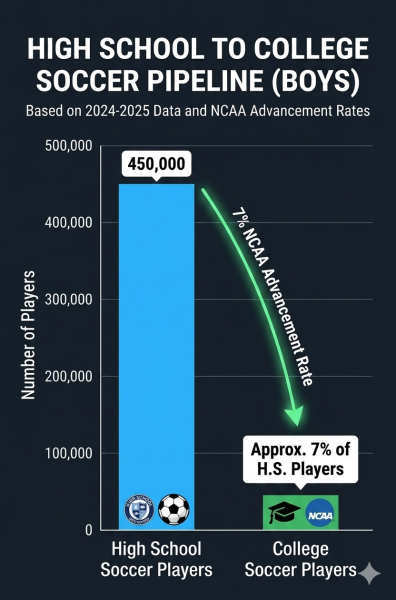
High school soccer is a big deal for students who play. It is one of the most popular sports. The National Federation of State High School Associations says that over 450,000 boys played high school soccer in the 2024-2025 season. The NCAA says that only about 7% of these players will play college soccer. This means that high school soccer programs are now focusing on helping players get into college and develop their skills for their future in the sport.
The Modern Recruitment Gauntlet
The days of simply “playing well” and hoping a scout is in the stands are over. Today’s student-athletes must treat the sport like a specialized curriculum. To secure a collegiate roster spot, players are expected to master advanced tactical positioning and execute high-pressure plays that translate to the college game.
For seniors, the workload is doubled. Beyond the physical demands of the season, they must act as their own marketing agents, meticulously editing “highlight reels” and attending hardcore ID camps during their limited free time. Furthermore, the “student” half of “student-athlete” has never been more critical.
“It is not about just being good at football anymore,” says Head Coach Andy Thomas. “College scouts are looking for the ‘total package.’ They want players who are tactically intelligent and have the discipline to succeed in the spotlight of a stadium as well as the rigors of a university classroom.”
The Senior Year Tightrope
The final season of high school soccer is a psychological tightrope. Seniors shoulder the program’s culture while fighting for their own collegiate future. Senior Captain Jackson Arrasin reflects on this dual responsibility: “As a senior, you have to do a lot more than just play soccer. You’re the culture setter for the team, but you’re also constantly aware that every touch on the ball could be part of your final audition for a scout. Managing that pressure while keeping your grades up is a full-time job.”
Coach Thomas said, “We want our seniors to know that high school soccer is the beginning. Whether they play in college or not, we want them to learn as much as they can and be ready for the next level.”
At the end of the season, the team looks at how they did. Not all players will play soccer in college. Playing high school soccer helps them get ready for the future. It teaches them discipline and how to work hard. High school soccer programs will continue to focus on helping players get into college and develop their skills.
 Beyond the Scoreboard
While the ultimate goal for many is a college scholarship, Coach Thomas emphasizes that the value of a high school program isn’t measured solely by recruitment numbers. The daily grind,, the 6 a.m. practices, the film studies before the games, and the balancing of travel games with homework build a foundation of resilience within the team.
“We want our seniors to know that high school soccer is just the beginning,” Thomas notes. “Whether they play in college or hang up their boots after graduation, we want them to leave this program with the discipline and work ethic required for the next level of life.”
A Lasting Legacy
As the final whistle blows on the season, the metrics of success are twofold. On the surface, the team looks at wins, losses, and recruitment letters. Beneath that, however, lies the true impact of the shift in high school soccer: the development of young men who are prepared for the “real world.” By focusing on the intersection of performance and academic accountability, high school programs ensure that even those who fall outside the 7% are equipped to win long after they leave the pitch.